
Best Roof Vents for Attic Cooling
Updated: Oct 9
A hot second floor in July usually points to the same issue - trapped attic heat with nowhere to go. Choosing the best roof vents for attic cooling can lower attic temperatures, reduce strain on your HVAC system, and help your roof last longer, but the right answer depends on your roof design, insulation, and airflow balance.
Attic ventilation is not just about cutting heat. It is about moving air correctly. When intake and exhaust are sized and installed the right way, your attic can release superheated air in summer and reduce moisture buildup in colder months. When ventilation is mismatched, even a high-quality vent may not perform the way you expect.
What makes the best roof vents for attic cooling?
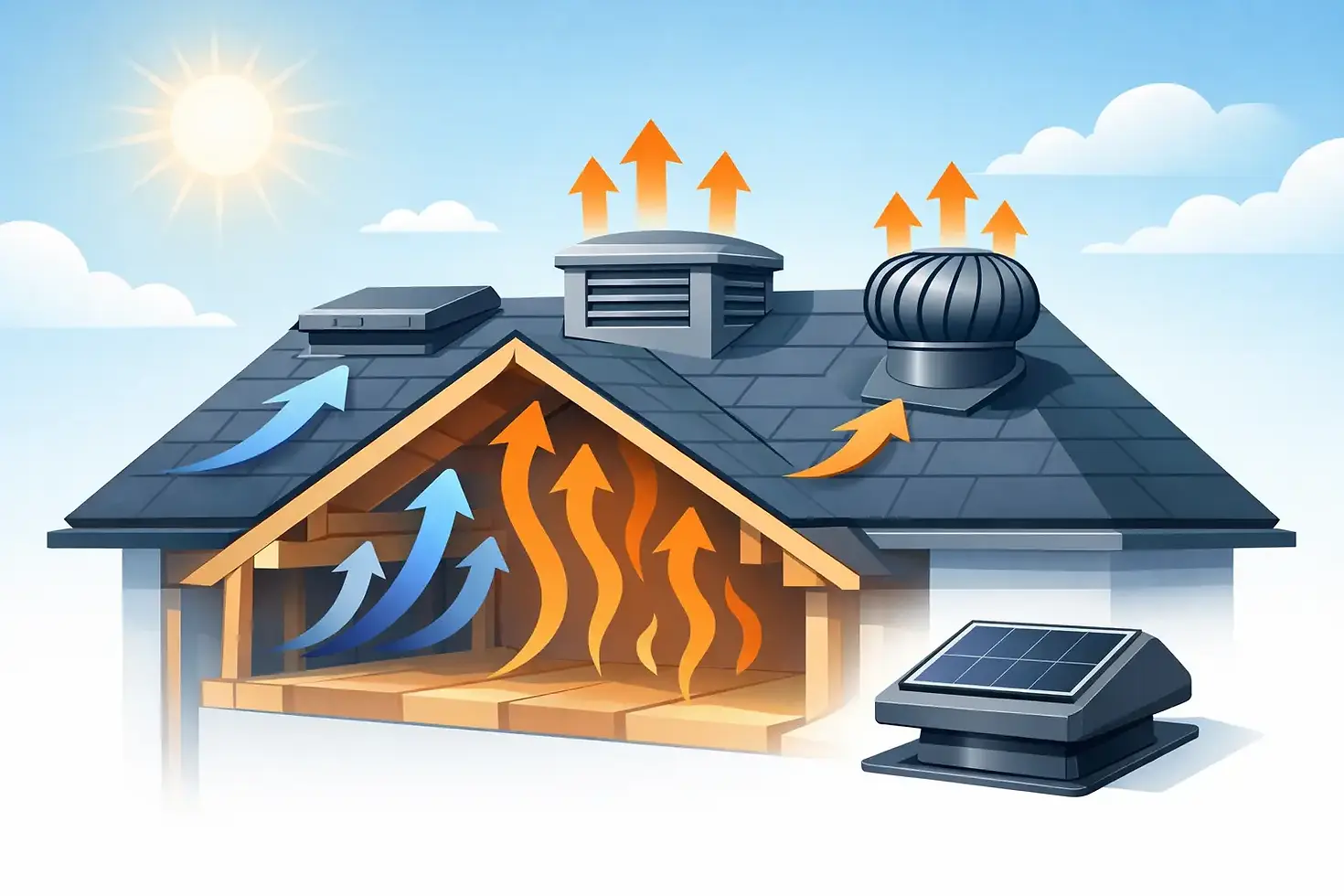
The best vent is not always the most powerful-looking option on the roof. It is the one that fits the structure of the home, provides steady exhaust, and works with proper intake ventilation, usually at the soffits. Exhaust without intake can pull air from the wrong places. Intake without enough exhaust can leave hot air trapped at the peak.
For most homes, the goal is balanced ventilation. Hot air naturally rises, so exhaust vents belong high on the roof. Cooler outside air should enter low. That creates a continuous path for airflow through the attic rather than pockets of stagnant heat.
In Indianapolis, that balance matters because homes deal with both humid summers and cold winters. A vent system that helps in July also needs to avoid creating moisture problems in January.
Ridge vents: the best fit for many homes
Ridge vents are often the best roof vents for attic cooling on homes with a simple roofline and a long, continuous ridge. They run along the roof peak and allow rising hot air to escape evenly across the highest point of the attic.
This design has a few real advantages. Ridge vents are low-profile, so they do not stand out visually the way box vents or powered units can. They also vent evenly, which helps avoid hot spots. When paired with continuous soffit intake, they create one of the most effective passive systems available.
That said, ridge vents are not ideal for every roof. If the ridge line is short, broken up, or interrupted by complex framing, the vent may not provide enough exhaust area. Performance also drops if soffit vents are blocked by insulation or if the attic has poor air pathways.
A ridge vent is usually the strongest option when the roof shape supports it and the intake side is handled correctly.
Box vents: simple, dependable, and sometimes the right choice
Box vents, also called static vents or roof louvers, sit near the upper portion of the roof and let heat escape through fixed openings. They do not require electricity, they have no moving parts, and they can work well on homes where a ridge vent is not practical.
Their biggest advantage is flexibility. On a roof with multiple sections, hips, valleys, or limited ridge length, several box vents may provide better coverage than trying to force a ridge vent system where it does not belong. They are also straightforward to replace if one becomes damaged.
The trade-off is appearance and airflow consistency. Because box vents are spaced apart, ventilation can be less uniform. They are also more visible from the ground. If too few are installed, or if placement is poor, parts of the attic may still hold heat.
For some homes, though, static roof vents are the honest, practical answer. Not every house needs a more complicated system.
Wind turbines: effective when conditions are right
Wind turbine vents use moving vanes to pull hot air out of the attic as wind passes through them. When they are spinning properly, they can move a significant amount of air without using electricity.
They can be effective in open areas with consistent wind, but they are more conditional than ridge or box vents. If wind is light, their performance drops. They also include moving parts, which means more wear over time. Homeowners sometimes find them noisier than expected, especially as they age.
In a market like Indianapolis, where wind conditions can vary by neighborhood and season, turbines can work, but they are rarely the first recommendation for a balanced, low-maintenance system.
Powered roof vents: strong exhaust with important caveats
Powered attic vents use electric or solar-powered fans to force hot air out of the attic. On paper, they sound like the strongest solution, and in some cases they do help with extreme heat buildup. They are most often considered when an attic has persistent high temperatures and passive ventilation alone has not solved the issue.
The caution is that powered vents can create negative pressure if the attic does not have enough intake air. When that happens, the fan may start pulling conditioned air from the living space below instead of drawing fresh air from outside. That can raise energy costs instead of lowering them.
There is also the issue of maintenance and lifespan. Motors, thermostats, and controls can fail. Solar models avoid wiring costs, but they still depend on proper placement and adequate sunlight.
A powered vent is usually best treated as a targeted solution, not a default upgrade. It works best when the attic has already been evaluated for insulation, air sealing, and intake ventilation.
Off-ridge vents and other specialty options
Some roofs do not have enough ridge length for a standard ridge vent system. In those cases, off-ridge vents can provide high-level exhaust in a more compact format. These vents sit near the ridge and offer more airflow than a typical box vent while working on roofs with limited peak area.
They can be a good middle-ground option, especially on roof designs that do not lend themselves to continuous ridge venting. The main drawback is that they are still more visible than a ridge vent and require careful layout to perform well.
Gable vents are another option you may see on older homes. They are installed in the exterior wall of the attic rather than on the roof itself. Gable vents can help, particularly when paired with a fan, but by themselves they often leave dead air pockets in parts of the attic. They are usually not the best standalone answer for whole-attic cooling.
The vent you choose matters less than the system around it
This is where many homeowners get led in the wrong direction. Vent products get the attention, but attic performance depends on the full assembly. If insulation is blocking soffit vents, if bathroom fans dump moisture into the attic, or if air leaks from the house are feeding heat upward, the vent type alone will not fix the problem.
A good ventilation plan should consider roof slope, attic square footage, ridge length, existing intake, insulation levels, and the age of the roof. Mixing vent types can also cause problems. For example, combining ridge vents with gable vents or powered vents can short-circuit airflow, causing air to enter and exit at the top instead of pulling through the full attic space.
That is why the best roof vents for attic cooling are usually selected as part of a system, not as a standalone product choice.
Which roof vent is best for your home?
If your home has a straightforward roofline, a continuous ridge, and working soffit intake, ridge vents are often the best overall choice. They are efficient, low-profile, and dependable.
If your roof has a more complex shape or limited ridge length, box vents or off-ridge vents may be the better fit. They can be placed where they are needed and adjusted to the roof layout.
If you have a persistent heat problem in a difficult attic, a powered vent may help, but only after confirming that intake ventilation and insulation are not the real issue. Wind turbines can still perform well in certain locations, but they are more situational and generally involve more maintenance over time.
For homeowners who want clear guidance, this is where a professional inspection matters. A trustworthy roofer should be able to explain not just what vent they recommend, but why it fits your roof and what trade-offs come with it. At 3 Kings Roofing and Gutters, that kind of straightforward explanation is part of the job.
A few signs your attic ventilation needs attention
You do not need to wait for a roof replacement to address ventilation. Warning signs often show up inside the house first. Rooms that stay hotter than the rest of the home, rising summer cooling bills, musty attic odors, or shingles that appear to age unevenly can all point to poor attic airflow.
In winter, frost or moisture in the attic is another red flag. Good ventilation helps release humid air before it condenses on cold surfaces. That is one reason attic ventilation should never be viewed as a summer-only upgrade.
The right vent setup should work quietly in the background year-round. If your attic feels like an oven every summer, the better question is not which product is most popular. It is which ventilation system actually fits your roof, your home, and the way air moves through it.
Hot attic in Fishers?
If your attic runs hot in summer or you're seeing any of the warning signs above, 3 Kings can look at your ventilation as part of a free roof inspection. We install and repair attic vents, and if your roof is due for work anyway, a roof replacement in Fishers is the best time to get the airflow right. Call (317) 900-4336.



Comments